As an Amazon Associate, we earn from qualifying purchases. Some links on this site are affiliate links at no extra cost to you. Our recommendations are based on thorough research and editorial judgment.


How To Choose Audio Equipment For Different Room Types?

When choosing audio equipment for different room types, we should consider room size and shape. For smaller spaces, bookshelf speakers work well, while larger rooms benefit from floor-standing models for richer sound. Acoustic treatments can enhance clarity by reducing reverberation. Proper speaker placement is key—aligning them to form an equilateral triangle with seating boosts imaging. Finally, matching amplifier power to room size guarantees peak performance. There’s much more to explore about each aspect that can elevate your audio experience.
Key Takeaways
- Consider the room size; larger spaces require more powerful speakers for optimal sound clarity, while smaller spaces benefit from compact bookshelf speakers.
- Evaluate speaker placement to maximize sound quality; front speakers should be positioned 25-30 degrees off-axis and align with seating.
- Utilize acoustic treatments to minimize reverberation, ensuring clearer sound in both educational and recreational environments.
- Match amplifier power with room dimensions; smaller rooms need less power, but larger rooms may require significantly higher power to prevent distortion.
- Select speaker types based on room use; soundbars are suitable for TVs, while in-wall speakers integrate nicely into multi-room setups.
Understanding Room Size and Shape
You may be interested


When we’re choosing audio equipment for our spaces, it’s essential to take into account how room size and shape directly influence sound quality. Larger rooms allow sound waves to travel freely, enhancing immersion, while smaller spaces can create those “boxy” sound reflections that distort audio clarity. Additionally, speaker placement plays a significant role in optimizing sound quality for the best listening experience.
Selecting the Right Type of Speakers

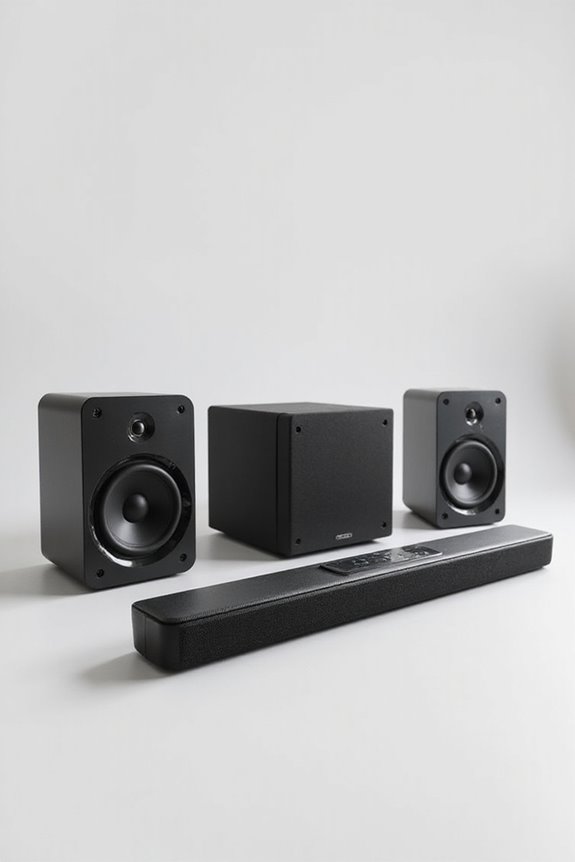
Selecting the right type of speakers is a key step in optimizing our audio experience once we’ve considered the room size and shape. For smaller spaces, bookshelf speakers deliver impressive sound quality without taking up too much room. If we’ve got a larger area, floor-standing speakers can provide rich bass and fuller sound coverage. Let’s not overlook soundbars, which enhance TV audio while maintaining a sleek aesthetic. For multi-room setups, in-wall or in-ceiling powered speakers are excellent choices, as they blend seamlessly into our decor. If outdoor listening’s on the agenda, weather-resistant speakers offer durability without compromising sound quality. Additionally, choosing speakers with IP ratings ensures they can withstand various weather conditions, enhancing their longevity and performance in outdoor environments. By carefully choosing speaker types suited to our needs, we create a more immersive audio environment.
Recommended Products

OUTDOOR TV DESIGNED FOR PATIOS & COVERED SPACES: This outdoor TV is built for outside use on patios, decks, and covered porches. Unlike indoor TVs, this outdoor television is weather-resistant and outdoor-rated, perfect as a patio TV.

OUTDOOR TV BUILT FOR FULL-SUN AREAS & PATIOS: Built for reliable outdoor entertainment on patios, decks, and covered porches. Weather-resistant and outdoor-rated, perfect for enjoying movies, sports, or gaming outside.

Importance of Acoustic Treatments

How well do we truly hear in our environments? The impact of acoustic treatments can’t be overstated. In untreated spaces, excessive reverberation can muddle sound clarity, making communication difficult. For instance, classrooms often face this challenge, with reverberation times around 1.9 seconds, hindering learning. By implementing effective acoustic treatments, we can bring this down to a mere 0.7 seconds, greatly enhancing student comprehension.
Additionally, in hospital settings, reducing ambient noise by 5–11 dB(A) improves not just communication but also overall well-being for both patients and staff. Through thoughtful design, we create spaces that are not only more pleasant but also conducive to clear communication and focus, ultimately enhancing our collective experience in these environments. Karaoke amplifiers can also benefit from proper acoustic treatment to ensure optimal sound quality during performances.
Recommended Products

Reduce Noise: After professional testing, the sound barrier rate of this product is as high as 70%, effectively reducing about 30-40 decibels of noise and having excellent sound insulation effect

Includes 4 Pieces per Case | 31.68 Square Ft. Per Case | Case Weight 48 lb |TILE SIZE: 9.5 in. W x 120 in. L x 0.8 in. T

[ Low Noise Level ] Equipped with 2 layers of soundproof laminated glass, and Acoustic Insulation Structure walls 6 layers (Aluminum frame structure, Film-laminated Steel Panel, PET Sound-absorbing Board, Eco-friendly Acoustic Panel, Premium Textured Fabric), the booth achieves 35dB(±5dB) reduction, ensuring a peaceful, private workspace.
Optimal Speaker Placement and Configuration

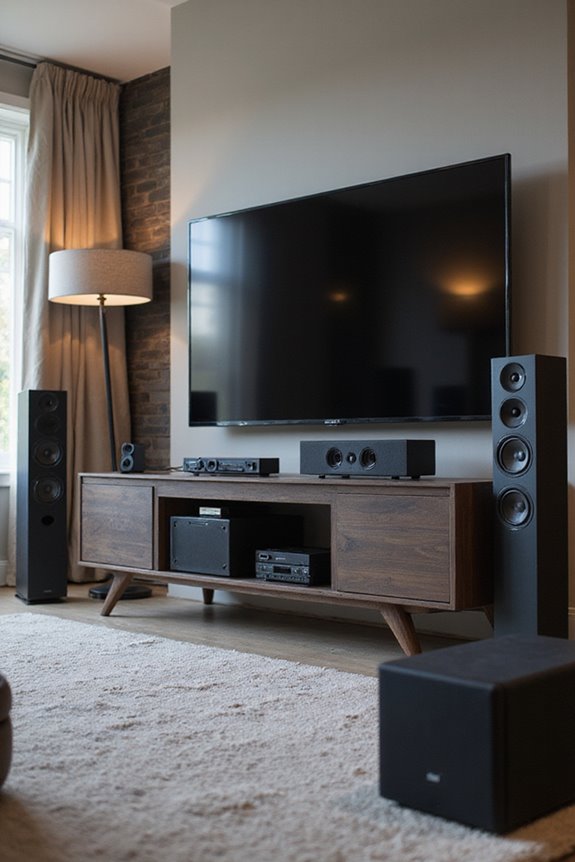
Getting speaker placement right can make a significant difference in your audio experience—especially in dedicated listening rooms or home theaters. We should aim for our front speakers to sit 25-30 degrees off-axis from our main listening position, ensuring the best speaker orientation. It’s essential to align them in an equilateral triangle with our seating for better imaging.
When it comes to the center channel, positioning it at ear height, directly facing us, enhances vocal clarity. For surround speakers, placement at 90-110 degrees off-axis is ideal. Adjusting the soundstage effectively involves defining our room layout; avoid corners to reduce unwanted reflections. Additionally, incorporating advanced audio technologies can significantly enhance the overall sound quality and immersion of your system.
Recommended Products

BRIGHTNESS BOOSTER MAX: The LG OLED evo shines even brighter than before. Brightness Booster Max technology magnifies each individual pixel for luminous quality that shines with every detail.

DIMESIONS: 150-inch Diagonal, 16:9 Aspect Ratio. View Size: 73.5" H x 130.7" W. Overall Size: 92.8" H x 150.4" W x 4.0" D. Extra 12-inch Drop. Black Aluminum Case.

LG OLED EVO: The LG OLED evo G-Series comes loaded with the a9 AI Processor Gen6—made exclusively for LG OLED—for even better picture and performance. Brightness Booster Max adjusts the picture for up to 70% brighter images* so you can see rich, vibrant colors and incredible contrast, even in well-lit rooms. AI tech and deep learning sense what you're watching and select the best picture and sound settings for an immersive viewing experience.
Matching Power and Specifications
When we consider the intricacies of matching power and specifications in audio equipment, it’s important to guarantee our amplifier’s output aligns with both our speakers and room dimensions. For instance, in smaller spaces under 80 cubic meters, we often can get away with less power. However, in larger rooms around 240 cubic meters, we might need to quadruple our power to maintain volume and clarity. Power headroom plays a significant role here, ensuring we have extra capacity to prevent distortion during lively moments. Additionally, impedance matching is fundamental; we must select amplifiers that pair well with our speakers’ ratings, usually between 4 and 8 ohms. This balance ultimately leads to a more dynamic and satisfying listening experience. Furthermore, understanding power output options can help you choose an amplifier that fits your specific needs for sound coverage and clarity.
Recommended Products
【Powerful AMD Ryzen AI Max+ 395 CPU and AMD Radeon 8060S GPU Bring the Future to Your Fingertips】 — 16 Zen 5 CPU cores, combined with the advanced Radeon 8060S iGPU, next-gen XDNA 2 NPU, and 126 AI TOPS, deliver cutting-edge architecture that significantly boosts the GTR9 Pro's performance, ideal for editing, rendering, designing, live streaming and AAA gaming

💆 [WORLD MASSAGE THERAPY] - We spent 5 years studying different massage techniques from around the world in order to design the perfect chair. This is the ONLY massage chair that features Japanese Shiatsu 3D Neck & Shoulder Massage, Ancient Roman Therapy, Turkish Treatment, Ancient Egyptian Massage, Greek Stress Relief, Indonesian Deep Tissue Therapy, New Delhi Yoga Stretching, Swedish Air-cell Therapy, and Hawaiian Sleeping Massage.

The RotoFlex pump is a rugged pump with a unique flow-through design; delivers smooth material flow for uniform coverage & consistent spray pattern
Adapting to Room Usage and Environment
While every room has its unique acoustic characteristics, we can greatly enhance our audio experience by tailoring our setup to meet specific usage needs. Understanding room functionality is key to making informed choices. For instance, a home theater might thrive on a little extra reverberation for immersive sound, while a workplace demands minimal echo for clear communication.
Recommended Products

SPECS - Length: 96" | Width: 80" | Material: Cotton and Polyester with Zig-Zag Stitching | Weight: 12 lbs each | Blanket and Thread Color: Black | Use: Sound Absorption, NOT Sound Blocking or Sound Proofing | NRC Rating: 0.35 | Quantity: (60) Sound Blankets

Acoustic Room Treatment Kit with 12 Control Columns

Acoustic Room Treatment Kit with 12 Control Columns
Additional Tips for Enhanced Audio Experience
Enhancing our audio experience requires us to contemplate several practical strategies that can make a significant difference in any space. First, let’s consider audio calibration; using methods like automatic speaker calibration tools can simplify tuning. Plus, we can adjust our equalizer settings to correct for room acoustics, ensuring balanced sound without distortion.
Sound optimization plays a vital role, too. Experimenting with speaker placement and toe-in angles allows us to direct sound more accurately toward our listening area. Implementing bass traps and diffusers will manage reflections and improve clarity in our rooms. Finally, regular maintenance of our equipment and proper isolation can preserve that crisp audio we all cherish, making each listening session more enjoyable.
Frequently Asked Questions
How Do I Measure My Room for Audio Equipment Selection?
We can’t expect great sound without measuring our room’s dimensions, can we? By understanding sound reflections, we’ll capture the right acoustics and create a space where our audio gear truly shines and connects us.
Can I Use Outdoor Speakers Indoors for Better Sound?
While we might think outdoor speakers could enhance our indoor experience, the outdoor acoustics and speaker placement often lead to overpowering sound. Instead, let’s focus on indoor speakers for a richer, more immersive audio journey together.
What’s the Impact of Room Color on Audio Quality?
Room color definitely influences our audio experience! It’s fascinating how color psychology shapes our perception of sound, affecting room acoustics and creating a more immersive atmosphere for everyone. Let’s explore this impact together!
Are Vintage Speakers Suitable for Modern Audio Systems?
When exploring the charm of our vintage speakers, we find they can harmoniously blend with modern systems. Ensuring vintage compatibility enhances sound quality, making our listening experience rich and fulfilling, bridging nostalgia with contemporary elegance.
How Do I Manage Audio Equipment Setup for Shared Spaces?
When managing audio equipment in shared spaces, we need to focus on ideal shared acoustics. For a successful multi-user setup, let’s guarantee balanced speaker placement and use soft furnishings to enhance sound quality together.