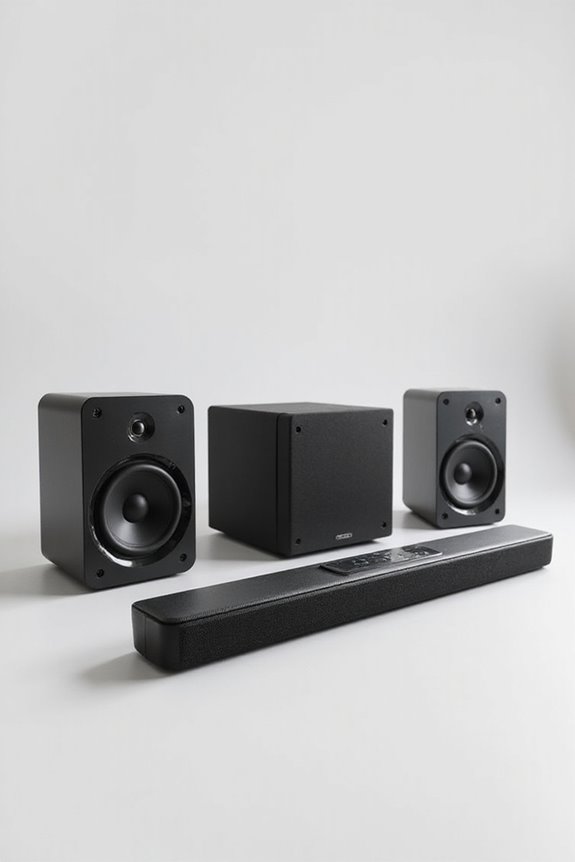
As an Amazon Associate, we earn from qualifying purchases. Some links on this site are affiliate links at no extra cost to you. Our recommendations are based on thorough research and editorial judgment.

How To Set Up Surround Sound Speakers At Home?

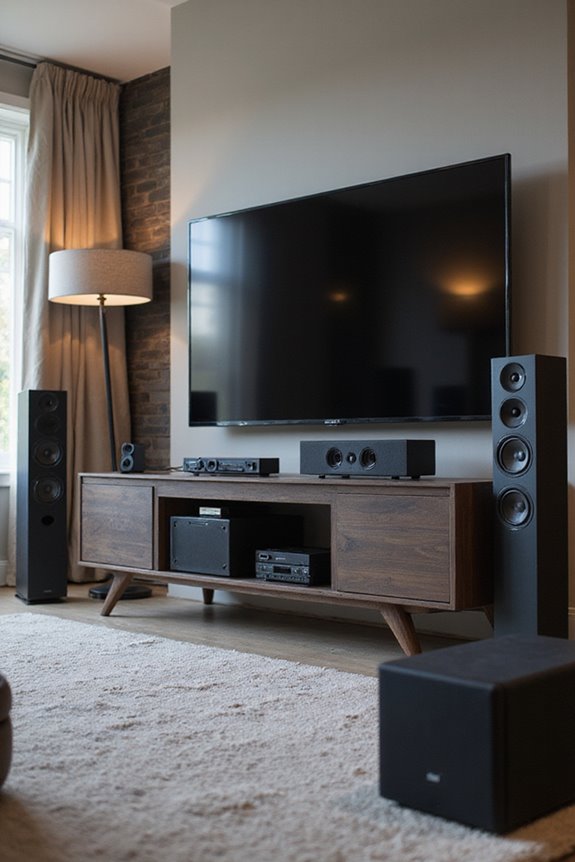
To set up surround sound speakers at home, we should start with a suitable room, ideally at least 12 feet by 16 feet. Next, we angle our front speakers inward at 22-30 degrees and position the center speaker directly with the screen. Using quality wiring, we maintain correct polarity and label our connections for clarity. Afterward, we calibrate the receiver for uniform sound levels. This foundational setup guarantees an improved audio experience—let’s explore more detailed tips for fine-tuning your system.
Key Takeaways
- Select an adequate room size, ideally 12 ft x 16 ft or larger, for optimal sound experience and viewing comfort.
- Position front left and right speakers angled inward at 22-30 degrees, with the center speaker aligned with the screen.
- Place surround speakers at 90-110 degrees from the center, directed towards listeners for immersive audio.
- Utilize quality speaker wire, maintaining consistent polarity to avoid phase cancellation, and secure connections with binding posts or banana plugs.
- Calibrate your receiver using test tones and an SPL meter to achieve uniform sound levels and optimize sound quality throughout the room.
Room Selection and Layout
You may be interested

When we set out to create the perfect surround sound experience, choosing the right room often becomes a vital first step. We should aim for rectangular rooms, ideally measuring about 12 ft x 16 ft or larger, to minimize sound reflections and improve audio quality. These dimensions support screen sizes of 100–120 inches while allowing comfortable seating arrangements. It’s important to take into account room dimensions, ensuring proper distances between seats and the screen for best viewing. Additionally, acoustic treatment in larger spaces can help manage sound waves and prevent annoying echoes. Let’s also think about aisle spacing—maintaining at least 14 inches is significant for comfort. By thoughtfully selecting and configuring our room, we can truly enhance our surround sound experience. Incorporating features like subwoofer performance will further amplify the cinematic experience in your setup.
Speaker Placement Techniques
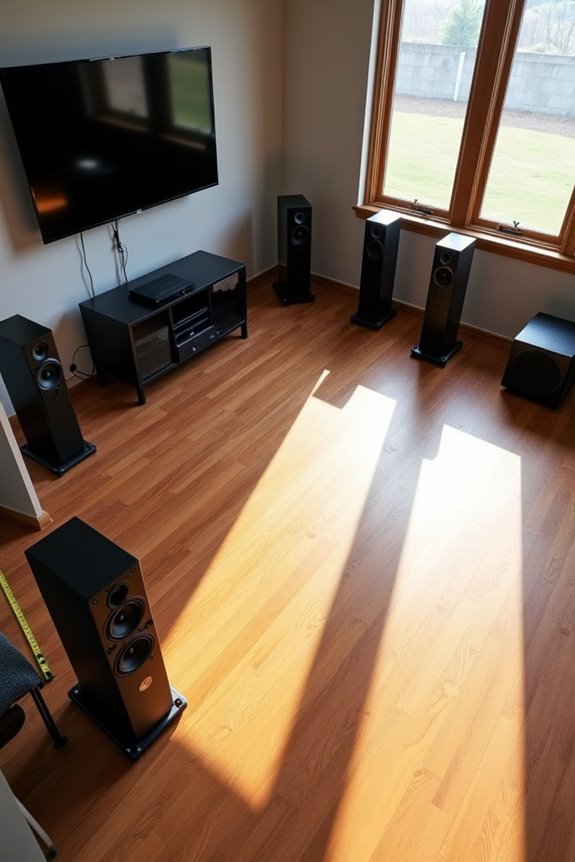
One of the most essential factors in achieving an immersive surround sound experience is the careful placement of speakers. Proper speaker positioning is key; for instance, we should angle our front left and right speakers inward towards our listening area, ideally about 22-30 degrees. The center speaker should align perfectly with the screen to guarantee dialogue clarity.
Surround speakers need to be positioned at about 90-110 degrees from the center, aimed directly towards us for optimum audio focus. When it comes to subwoofers, placing them near a wall while avoiding corners helps eliminate muddiness. By implementing these strategies, we’re on our way to significant audio optimization that enhances our overall listening experience. Additionally, understanding speaker configurations can further enrich your setup by tailoring the audio output to match your space and preferences.
Connection and Wiring Essentials
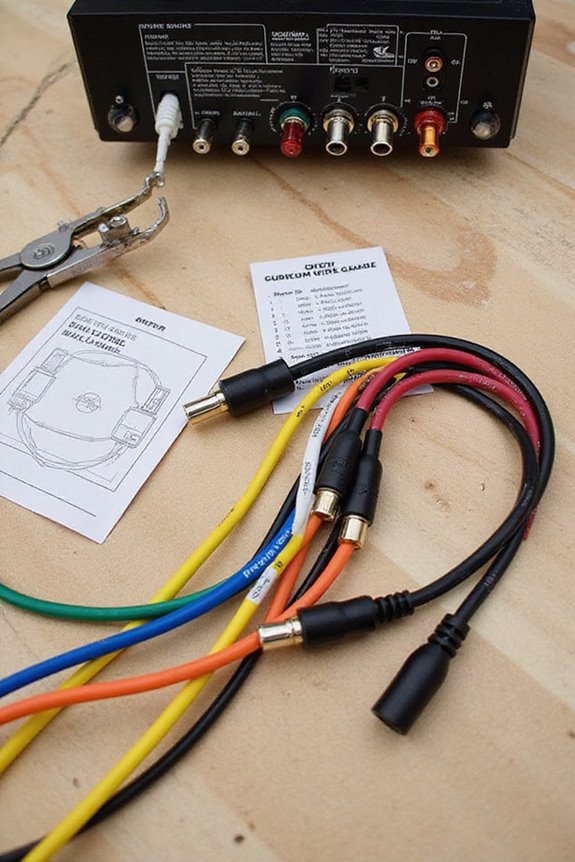
Setting up surround sound speakers involves not just placement but also the right connections and wiring to guarantee peak performance. First, we’ll need quality speaker wire—16 AWG works great for most home setups. Remember, maintaining connection polarity is vital for ideal sound quality. Positive and negative terminals should match on both the speakers and receiver; you’ll often find red for positive and black for negative. As we connect, let’s verify consistent polarity across all speakers to avoid phase cancellation. Using binding posts or banana plugs can secure our connections, reducing signal loss. Don’t forget to label wires for easy identification later on. When we get these essentials right, we’ll truly enjoy our surround sound experience! Additionally, many amplifiers support advanced audio formats like Dolby Atmos for an immersive audio experience.
Receiver Setup and Calibration
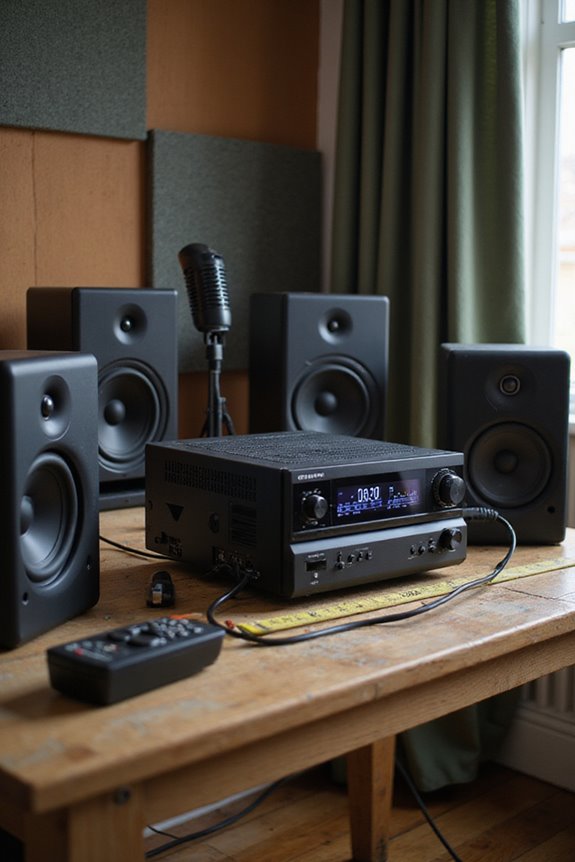
To achieve the best possible surround sound experience, we need to focus on the receiver setup and calibration. First, let’s adjust the speaker level using our AV receiver’s controls. By doing this, we guarantee uniform loudness across all speakers. Using test tones and an SPL meter, we can target a standard level, typically around 75 dB.
Modern AV receivers often come with auto calibration features that optimize sound automatically. With a calibration mic positioned at ear height, these systems analyze room acoustics, adjusting levels and distances effortlessly. For those of us seeking a personalized touch, manual techniques using the SPL meter allow for precise adjustments. Balancing these methods can enhance our listening experience markedly as we fine-tune our beloved surround sound setup. Additionally, considering acoustic treatments can further improve sound quality in your home theater environment.
System Configuration Options

When we consider setting up our surround sound system, several configuration options can truly elevate our listening experience. The 5.1 system is often the go-to, with five speaker types and one subwoofer, perfectly suited for standard audio formats like DVDs. If we want more depth, a 7.1 setup adds two back surround speakers, enhancing spatial awareness. For those seeking ultimate immersion, a 9.1 system brings height speakers into the mix, transforming our audio environment. Alternatively, a 2.1 configuration is great for simple stereo setups, offering improved sound over TV speakers. Each option guarantees we find the perfect fit for our space while maximizing our enjoyment of our favorite movies and shows, aligning with our audio preferences. Additionally, integrating systems with Dolby Atmos can significantly enhance the immersive experience by providing overhead sound for a more cinematic feel.
Recommended Products

LOWEST EVER, WHILE SUPPLIES LAST @ $6077 (save $2122). Built on 70+ years of audio legacy & the legendary NAKAMICHI DRAGON name, this #1-rated extreme system is the dream theater everyone talks about, driven by our 11.4.6-ch architecture + Pro-Cinema Engine. Dream plug-and-play performance made simple.

Dolby Atmos Surround Sound: Lose yourself in the moment, with a three-dimensional listening experience. Feel the real power of your favourite TV shows and films.
Frequently Asked Questions
What Types of Speakers Are Best for Surround Sound Systems?
Did you know that 70% of sound immersion comes from proper speaker placement? We can enhance our surround experience with floor-standing, bookshelf, and wall-mounted speakers, ensuring sound calibration aligns for ideal fidelity and immersion.
How Can I Minimize Audio Delay in My Setup?
To minimize audio delay, we can use audio synchronization techniques like adjusting settings on our devices. Implementing latency reduction methods, such as direct HDMI connections, helps us achieve a smooth audio experience together.
Do I Need Special Cables for Subwoofers?
When we think about subwoofer placement, we definitely need to take into account the right cable types. Using high-quality, specially shielded subwoofer cables guarantees we get the best sound experience together, free from interference and noise.
Can I Use Wireless Speakers for Surround Sound?
Absolutely, we can use wireless speakers for surround sound! They offer advantages like reduced clutter, yet we should be mindful of potential wireless connection issues that can impact audio quality. Let’s guarantee ideal placement and setup together!
How Often Should I Update My AV Receiver?
Just like fine wine, we think AV receiver longevity deserves careful consideration. Upgrading frequency should reflect genuine improvements, not trends. Let’s cherish our gear, opting for updates when real benefits come along—patience pays off in sound quality!