As an Amazon Associate, we earn from qualifying purchases. Some links on this site are affiliate links at no extra cost to you. Our recommendations are based on thorough research and editorial judgment.

What Makes Studio Monitor Speakers Different From Regular Speakers?

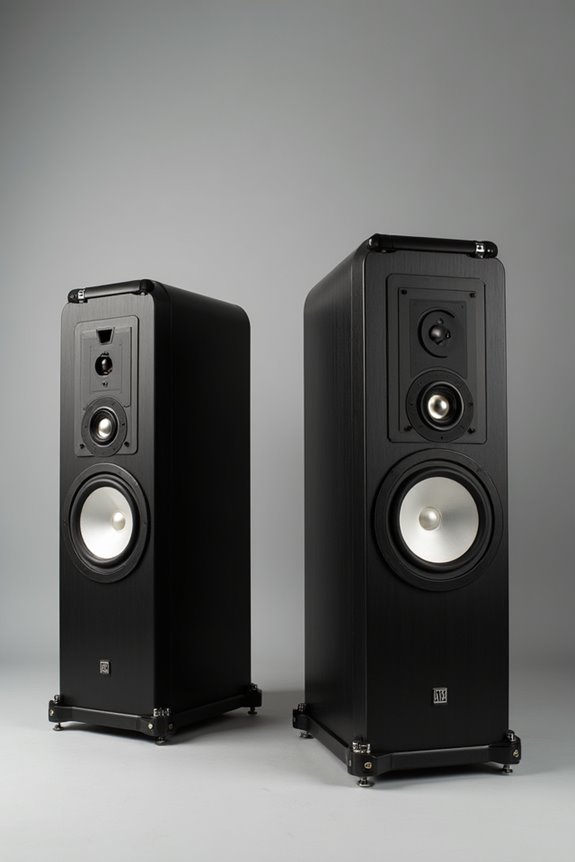
When we look at studio monitor speakers, we see they’re designed for accuracy in sound reproduction. Unlike regular speakers, monitors offer a flat frequency response, allowing us to hear music without added colorization. They also feature built-in amplifiers for better power delivery and clarity. Additionally, monitors are often used in nearfield setups, minimizing room reflections for more precise audio. Curious about how this impacts mixing and mastering? There’s so much more to explore!
Key Takeaways
- Studio monitor speakers provide a flat frequency response, ensuring sound transparency and accurate tonal balance compared to regular speakers with colored sound profiles.
- Built-in amplifiers in studio monitors optimize power delivery, reducing distortion and maintaining clarity during sound playback, unlike typical passive speakers.
- Nearfield design allows monitor speakers to prioritize direct sound over room reflections, making them ideal for precise audio mixing in small spaces.
- Studio monitors often feature customizable bass and treble controls to fine-tune sound, whereas regular speakers may have limited adjustment options.
- Calibration techniques ensure consistent performance in studio monitors, facilitating reliable mixing decisions unlike regular speakers that may lack such precision.
Amplification and Internal Architecture
You may be interested


When we compare studio monitor speakers to regular speakers, one of the most notable differences lies in their internal amplification and architecture. Studio monitors often feature built-in amplifiers, which maximize amplifier efficiency and minimize signal degradation. This design means each driver can receive tailored power, enhancing clarity and reducing distortion considerably. For instance, tri-amped monitors can deliver over 100 watts per driver channel, guaranteeing a robust sound with smooth shifts between frequencies. The cabinet design also plays a vital role; internal bracing helps manage resonance, while materials are chosen to guarantee acoustic stability. By prioritizing these elements, studio monitors provide a precise listening experience that fosters creativity and accuracy, fundamental for anyone serious about sound production. Additionally, many studio monitors, like the Yamaha HS3, are designed with room control and high trim response controls for fine-tuning sound to specific environments.
Frequency Response and Sound Accuracy

While we might not give much thought to frequency response in our day-to-day listening, it plays an essential role in professional audio production. Studio monitors provide flat frequency response, ensuring sound transparency across all frequencies. This design avoids colorization, letting us accurately assess tonal balance in our mixes. With response accuracy typically held within ±2 dB, we hear the original audio signal, which is vital for mixing engineers. Plus, the extended frequency range—from low bass to high treble—means we capture almost all audible frequencies. This precision helps maintain the integrity of our tracks, fostering better mixing and mastering decisions. When we’ve got the right tools, we can truly elevate our sound and achieve our production goals. Additionally, the use of amplifiers with low total harmonic distortion ensures that the sound remains clean and accurate, further enhancing the quality of studio monitor performance.
Recommended Products

ASUS VivoBook Pro 16 OLED laptop comes with 16” 3.2K (3200 x 2000) OLED 16:10 aspect ratio with ultra-slim NanoEdge bezels
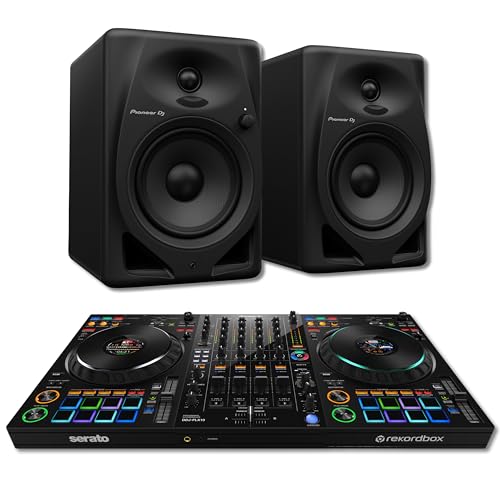
WHAT'S INCLUDED: Pioneer DDJ-FLX10 4-deck Rekordbox and Serato DJ Pro controller and Pioneer DM-50D powered nearfield desktop monitor speakers — a complete professional DJ studio setup with accurate reference monitoring from a matched-brand Pioneer signal chain.

3-way Powered Studio Monitor with 8" LF Driver
Intended Listening Environment: Nearfield Use

Understanding the significance of intended listening environments is essential for achieving ideal sound quality. When we adopt nearfield principles, we position ourselves close to the monitors—around 3 to 4 feet—allowing us to hear mainly direct sound rather than room reflections. This reduces unwanted coloration and improves our perception of stereo imaging. For best results, we should place our monitors symmetrically and maintain appropriate distances from walls to minimize reflections. Remember, the critical distance is where direct sound and reflections equal out; staying within this boundary enhances clarity. By following these guidelines, we can create a more accurate listening space, ultimately leading to better mixing and mastering outcomes. Your space matters—it brings our audio vision to life. Additionally, ensuring that your setup includes high-performance drivers can further enhance audio clarity and immersion in your nearfield monitoring environment.
Recommended Products

Powered 3-way Studio Monitor with 8.25" LF Driver

Latest modeling techniques used to minimize non-linear distortion Smoother off-axis response, more forgiving of diverse acoustical environments Compact polycarbonate composite cabinet Powerful highly efficient amplifiers with large headroom Wide range input gain and output level controls

Designed for Smaller Rooms: The Sub8 is designed for smaller rooms up to 20 square meters
Driver Configuration and Design

In studio monitors, driver configuration plays an essential role in our listening experience. Typically, we find multiple driver types—woofers, midrange drivers, and tweeters—designed to handle different frequency ranges. For example, a two-way system might consist of a woofer for bass and a tweeter for highs, while three-way setups add midrange drivers for added detail, especially in vocal tracks.
The enclosure design further enhances performance. Many studio monitors utilize sealed enclosures for tighter bass response, crucial for critical listening. With careful calculations of internal volume, we guarantee ideal resonance control and airflow. This thoughtful design helps maintain clarity, allowing us to hear our mixes accurately, helping us make informed decisions in our creative pursuits. Additionally, the customizable bass and treble controls found in various speaker models can further enhance the listening experience, allowing for fine-tuning based on personal preference.
Recommended Products

Active dual opposing 8-inch SVS drivers unleash massive slam and output with crisp, musical transients that’s all the more impressive given its compact 10-in cabinet.

20W Class-D power full-range amplifier for higher output level and less power consumption. Dedicated 4-inch full range driver for clear audio reproduction.

OPAL1 is a low sensitivity speaker and can handle up to 200 watts of power per speaker. In many cases, the extra power can improve the sound quality when compared to lower power amplifiers. Keep this in mind when selecting an amplifier to pair with the OPAL1.
Signal Processing and Calibration

After exploring driver configuration and enclosure design, we turn our attention to signal processing and calibration, which greatly impact our monitoring experience in the studio. Proper calibration techniques, like using pink noise at -18 dBFS, guarantee we achieve a consistent frequency measurement. Positioning an SPL meter at ear level in our sweet spot helps us adjust input sensitivity to reach the target loudness of 76 dB SPL per speaker. In advanced systems, signal processing features like automatic room compensation enhance accuracy. Experimenting with subwoofer phase and crossover settings not only guarantees smooth changes but also prevents frequency overlaps. By balancing our monitors within ±0.5 dB SPL, we maintain stereo imaging, vital for making informed mix decisions. Additionally, understanding amplifier compatibility ensures that we achieve the best performance from our studio monitors.
Recommended Products

Pro-grade accuracy: Dual Doppler radar + photometric cameras measure ball & club data like carry distance, spin, launch angle, club head speed, smash factor and more.

Bundle Includes: 2 x Adam Audio A7V Powered Two-Way Studio Monitor, 2 x FocusProAudio 25-Feet XLR Male to Female Microphone Cable, 2 x PX-TMXM2 1/4-Inch TRS to XLR Male to Male Balanced Cable (10-Feet), and Studio Monitor Isolation Pads for 8-Inch Speakers (Pair)

CONVENIENT: Easily control the device from the front panel and enjoy access to every feature
Purpose and Usage Differences
When we consider the purpose and usage of studio monitors versus regular speakers, we quickly realize how these two types serve distinct roles in audio production and listening experiences. Studio monitors prioritize accuracy with a flat frequency response, making them perfect for critical tasks like mixing and mastering. Their monitor advantages lie in nearfield listening, guaranteeing we hear every detail without room interference. On the other hand, regular speakers often enhance sound for enjoyment, which can lead to speaker limitations during production work. For instance, a bass-heavy speaker may mask flaws in a mix, while studio monitors allow us to make informed audio decisions that translate across playback systems. Choosing wisely guarantees we achieve the best results in our audio projects.
Recommended Products
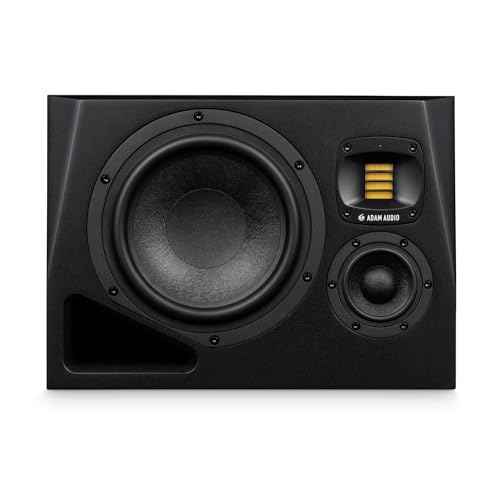
3-way Powered Studio Monitor with 8" LF Driver

This product is sourced from an authorized Soundcraft North American dealer and includes the official Soundcraft manufacturer’s warranty. The warranty is valid only for products purchased from authorized Soundcraft North American dealers within the United States.

EXCEPTIONAL SOUND PERFORMANCE - Savor the ultimate listening experience by pairing a fully loaded high fidelity turntable with endlessly versatile, room-filling 120-watt powered bookshelf speakers
Frequently Asked Questions
Can Studio Monitors Be Used for Casual Listening?
Sure, we can use studio monitors for casual listening, but we might miss that boosted warmth typical in regular speakers. Their audio fidelity shines in precision, yet it may not always feel engaging for relaxed enjoyment.
How Do I Choose the Right Studio Monitors?
When choosing studio monitors, we should consider studio monitor types and trusted studio monitor brands. Let’s explore our needs, room size, and budget to find the perfect match that enhances our audio experience together.
Do Studio Monitors Require Special Placement?
Absolutely, monitor placement’s essential for sound quality. We should focus on symmetry, distance from walls, and proper angles. Incorporating acoustic treatment enhances our listening experience, helping us achieve balanced, clear sound in our space.
What Size Studio Monitor Do I Need for My Space?
When choosing monitor size, we should consider our room acoustics first. Smaller monitors suit tight spaces, while larger models work better in spacious rooms. Let’s find the perfect fit for our unique creative environment together.
Are Studio Monitors Suitable for Home Theaters?
Did you know most studio monitors offer a flat frequency response up to 20kHz? While they have advantages in accuracy, their home theater compatibility can be limited. Engaging sound profiles might suit movie enthusiasts better!