As an Amazon Associate, we earn from qualifying purchases. Some links on this site are affiliate links at no extra cost to you. Our recommendations are based on thorough research and editorial judgment.


Which Speaker Placement Gives The Best Sound?

To achieve the best sound, we should place speakers using the Rule of Thirds, positioning them one-third of the way from the front wall. This minimizes early reflections and enhances audio clarity. Creating a balanced listening triangle is essential, with the speakers forming angles between 60° to 70°. Additionally, utilizing the Cardas Method can optimize distances from walls. By treating the room acoustically, we manage reflections that distort sound, leading to a truly immersive experience. Stick with us to explore more practical tips!
Key Takeaways
- Position speakers at least 2 feet from walls to improve bass response and avoid sound muddiness.
- Use the Rule of Thirds to place speakers one-third from the front wall for reduced early reflections.
- Create an equilateral triangle between speakers and the listener, with speakers angled slightly for better soundstage clarity.
- Employ the Cardas Method to determine ideal distances from walls, ensuring balanced sound across the room.
- Implement acoustic treatment to manage reflection points and enhance overall sound clarity in the listening environment.
Understanding the Importance of Room Dimensions
You may be interested


When we consider audio quality, it’s important to acknowledge that room dimensions play a crucial role in how sound behaves. In rectangular rooms, we typically experience better room acoustics than in irregularly shaped spaces. These shapes can create complex reflections that distort sound, making clarity a challenge.
Larger rooms demand more powerful speakers or adjustments to guarantee effective speaker performance throughout the area. To improve bass responses, we should keep speakers at least 2 feet from back walls. Additionally, choosing ideal dimensions, like those that follow the Golden Ratio, can help minimize sound issues. By understanding and optimizing our room size and shape, we enhance our listening experience considerably, turning our spaces into true audio havens. Furthermore, advanced audio technologies can significantly elevate sound quality in any setup.
The Rule of Thirds for Optimal Placement
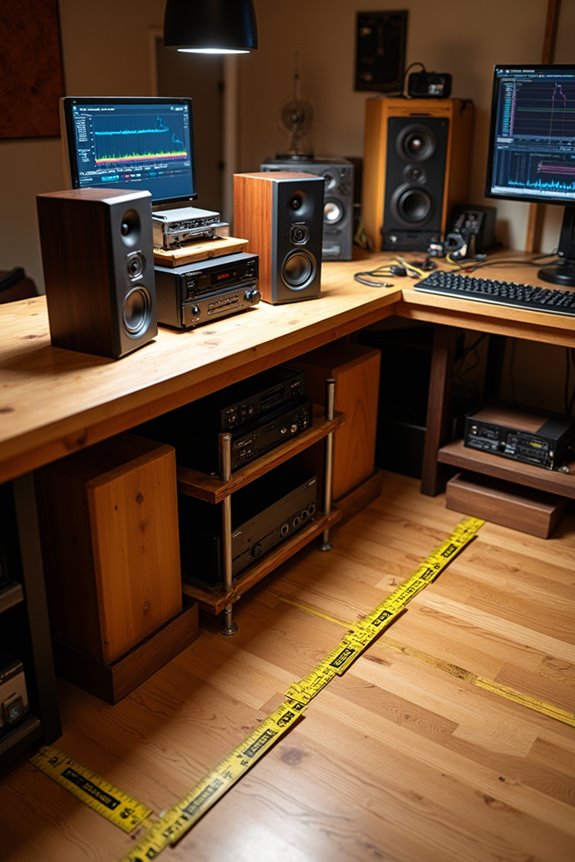
Understanding how room dimensions affect sound leads us to another vital aspect of enhancing our audio experience: the Rule of Thirds. By dividing our room length into three equal parts, we can improve speaker positioning for better sound clarity. For instance, placing speakers about one-third from the front wall minimizes early reflections, creating a more spacious soundstage. We often find our ideal listening position around one-third from the rear wall, fostering a balanced listening triangle with the speakers. Additionally, proper placement at ear level is crucial for achieving optimal audio performance. As we explore this guideline, remember that adjustments may be necessary based on unique room acoustics. Using masking tape to mark these distances can be a fun and practical approach, allowing us to tweak placements while listening to our favorite tracks for peak sound enjoyment.
Recommended Products

[CONVENIENCE]- Answer and view callers at your door remotely via your mobile iOS or Android device, whether you are at home or abroad. The smart video doorbell intercom system sends a push-notification to your smart phones and you could watch, talk and remotely unlock your gate through your smart mobile devices. Never miss a delivery or visitor again.

3x Brighter Colors (1), and reliable performance — 3LCD, 3-chip technology.

PURE ANALOG PERFORMANCE - The definitive vinyl record listening experience for beautifully warm and natural music, transporting you into the center of the performance
Creating the Ideal Listening Triangle

Establishing the ideal listening triangle is vital for maximizing our audio experience. To achieve this, we need to focus on listener positioning. Instead of sitting exactly at the triangle’s vertex, we should position ourselves about half a meter behind. This technique allows the acoustic axes from the speakers to intersect just beyond our ears, enhancing spatial perception.
Speaker separation matters too; ideally, we want a balanced angle between 60° to 70°. Let’s remember to keep our tweeters aligned at ear level for clear, accurate sound. It’s important to avoid placing our speakers too close to walls or corners, as reflective surfaces can muddy our listening experience. By fine-tuning these aspects, we can truly enjoy a more immersive audio journey. Incorporating features like Dolby Atmos can further elevate this experience by adding overhead sound effects.
Recommended Products

All-new K-702 midrange compression driver, featuring a polyimide diaphragm, for exceptional detail

Bundle Includes: Focal Aria K2 926 Ash Grey (Limited Edition) 3-Way Floorstanding Audiophile Tower Speaker, (Pair)

C3 Continuous Curved Cone design for improved mid/bass performance
Utilizing the Cardas Method for Speaker Arrangement
By thoughtfully applying the Cardas Method, we can greatly enhance our listening experience in any room. This approach uses specific Cardas ratios to optimize speaker placement for the best sound. For instance, the ideal speaker distance from the rear wall should be 0.447 of the wall’s length, while the distance from the side walls should be 0.276 of that same length.
Let’s put this into practice. If we have a 12-foot rear wall, our speakers should be approximately 53 inches from the rear wall and 32 inches from each side wall. By following these ratios, we’ll guarantee a balanced soundstage that pulls us into the music, making our listening sessions truly enjoyable together. Additionally, using high-quality sound quality and performance speakers can further enhance the audio experience, ensuring that every note is crisp and clear.
Recommended Products

WIDE RANGE OF APPLICATIONS: Mount the speaker wall mount bracket to the wall to enjoy perfect listening, suitable for any occasion such as: classroom, home, workstation, kitchen, gym, billiard room, etc

1-3/8" inner diameter

UNIVERSAL 35MM COMPATIBILITY: Fits standard 35mm (1.375") speaker stand poles for secure mounting of compatible PA speakers.
How Distance From Walls Affects Sound Quality
When we place our speakers too close to walls, not only do we risk muddled sound, but we also introduce early reflections that can distort our listening experience. These reflections arrive within 5 milliseconds, causing time smearing, which blurs clarity and stereo imaging. Ideally, we should keep our speakers at least 1 to 1.5 meters from the front wall to achieve balanced sound and prevent overwhelming bass boosts that can mask midrange details. While room gain can enhance bass response, too much of it creates uneven tonal balance. To mitigate these issues, we can adjust speaker placement and incorporate absorptive materials, striking the right harmony in our sound environment. Additionally, using amplifiers that support advanced audio formats can further elevate the listening experience. Let’s embrace these tips for an enriched listening experience together!
Recommended Products

4.0HP Quiet Motor & Auto Incline: Brushless motor with max 4.0 HP provides efficient and low-maintenance operation. Our Borgusi treadmill supports speeds up to 12 mph and a 20% auto incline, making it great for all kinds of workouts.

FLUSH MOUNT IN CEILING SPEAKERS - Wide sound dispersion designed speakers easily integrate with new and existing audio systems, traditional Passive speaker design, simply drive power from your home audio receiver or amp

FLUSH MOUNT IN CEILING SPEAKERS - Wide sound dispersion designed speakers easily integrate with new and existing audio systems, traditional Passive speaker design, simply drive power from your home audio receiver or amp
The Impact of Speaker Orientation and Toe-In
Understanding how speaker orientation and toe-in affect sound can greatly enhance our listening experience. The angle at which we position our speakers can either broaden the soundstage or sharpen imaging precision. More toe-in typically brightens the tonal balance, improving high-frequency clarity by directing sound toward us. However, this can narrow the width of the soundstage. When both speakers share identical toe-in angles, it guarantees accurate time alignment and enhances our sweet spot. Some speaker designs, like coaxial models, allow for such adjustments without compromising performance. Ultimately, finding the right balance of toe-in effects depends on personal preference and room characteristics, allowing us all to enjoy our favorite tracks with prime sound.
Recommended Products
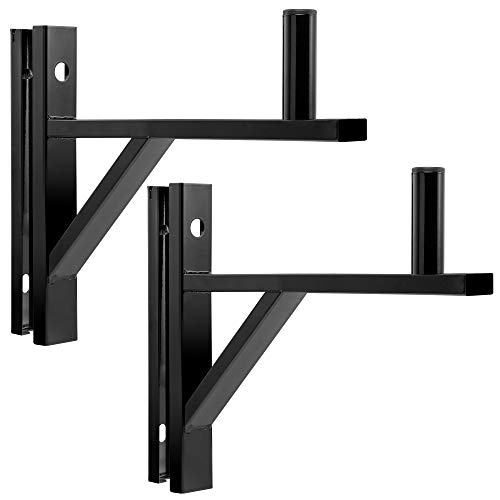
PAIR OF HEAVY DUTY METAL BRACKETS : extra strong metal brackets to support 15 inch PA speakers up to 90 Lbs. , comes pre drilled holes for 3 mounting positions to fit all sizes of speakers , can also fit 2 x 8 inch speakers on each bracket with the interchangeable metal posts

2-pack wall mount speaker brackets support speaker with 35mm adaptor

REPLACE YOUR STUDIO MONITOR STANDS AND NEATLY WALL MOUNT YOUR PA SPEAKERS: PA tripod stands takes precious floor space. Standard studio speaker stands have tripod legs that extend out taking up a large footprint. The audio wall mount speaker holder stands will help you free up all the space you need and, due to their innovative cable ring feature, they will keep your cords straight! The 35mm speaker pole mounts are the same on all standard PA speaker stands or speaker monitor stands.
Room Treatment: Managing Reflections and Acoustics
Proper speaker orientation and toe-in set the stage, but room treatment takes our listening experience to the next level. By implementing acoustic treatment, we can manage those pesky reflection points that skew our sound clarity. First, we should use the mirror method to identify reflection points on our side walls and ceiling, marking spots for our acoustic panels. Placing these panels strategically, extending at least 18 inches beyond the marked areas, effectively targets early reflections. We shouldn’t overlook the rear wall either, as treating it can greatly improve our sound stage. Together, these steps transform our listening environment, leading to a more accurate representation of music, enhancing our overall listening experience. Let’s elevate our space!
Empirical Testing for Fine-Tuning Speaker Placement
To achieve the best sound quality, utilizing empirical testing methods can greatly enhance our speaker placement strategies. By measuring speaker distance and employing reflection measurements, we can fine-tune our setups for peak performance. For instance, using impulse response plots in semi-anechoic chambers helps us identify problematic reflections, guiding us toward ideal positioning.
We should consider positioning the speakers and listening seat at the corners of an equilateral triangle, ensuring consistent distances to preserve an ideal sound ratio. Additionally, conducting far-field microphone measurements allows us to capture direct sound and analyze it against ground plane measurements. This iterative process of adjustment not only refines our placement but also deepens our understanding of how different environments impact acoustic performance.
Adjusting for Bass Response and Imaging Clarity
While we often focus on speaker placement for creating an immersive listening experience, balancing bass response and imaging clarity is equally essential. For ideal bass clarity, positioning speakers 6-12 inches from walls can help reduce muddiness and improve definition. Experimenting with placement and employing the “subwoofer crawl” method allows us to discover the strongest bass in our listening space.
To enhance imaging focus, we should form an equilateral triangle between our ears and speakers, toeing them in slightly. This approach sharpens the sound stage while maintaining stereo separation. Keeping tweeters at ear level also enhances clarity in high frequencies, streamlining our overall audio experience. A little adjustment can go a long way in achieving outstanding sound quality.
The Role of Room Shape and Dimensions in Placement Choices
Room shape and dimensions greatly influence our speaker placement choices, shaping how sound waves interact within our listening environment. In rectangular rooms, we often face speakers toward the longer wall to combat room acoustics challenges, while square rooms may benefit from creating “Golden Rectangles” or diagonal placements to reduce speaker interference. For odd-shaped rooms, a customized approach is essential—traditional setups might not work. We should also consider ceiling height, as taller ceilings can introduce additional resonances. Avoid seating near the midpoint of a room’s dimensions to mitigate bass nulls. By understanding our room’s unique characteristics, we can create an ideal listening experience that showcases our sound system’s true potential.
Frequently Asked Questions
Can Furniture Placement Affect Speaker Sound Quality?
Absolutely, our furniture arrangement plays an essential role in sound quality. By managing sound reflection, we can enhance clarity and immersion, creating a better listening experience together while enjoying our favorite music or movies.
How Important Is Speaker Height for Optimal Sound?
Like tuning a fine instrument, achieving ideal sound hinges on speaker height. By aligning them at ideal ear level, we enhance sound dispersion, creating an immersive experience that bonds us to the music and each other.
Do Different Speaker Types Require Unique Placement Strategies?
Absolutely, different speaker types do require unique placement strategies. By understanding acoustic considerations, we can achieve sound optimization together, ensuring that our audio experience resonates fully, regardless of whether we’re using floor-standing, bookshelf, or surround speakers.
Can I Use Wireless Speakers in Any Placement Arrangement?
When it comes to wireless speaker placement, we can’t just toss them anywhere and hope for magic. To truly embrace sound quality, we need to contemplate wireless range and position them wisely for a harmonious experience.
How Does Room Volume Influence Speaker Placement Effectiveness?
When we explore room volume, we find that it greatly shapes our speaker placement effectiveness. Larger spaces complicate sound reflections, impacting acoustics. Together, we can minimize distortion and enhance our overall listening experience by choosing wisely.