As an Amazon Associate, we earn from qualifying purchases. Some links on this site are affiliate links at no extra cost to you. Our recommendations are based on thorough research and editorial judgment.

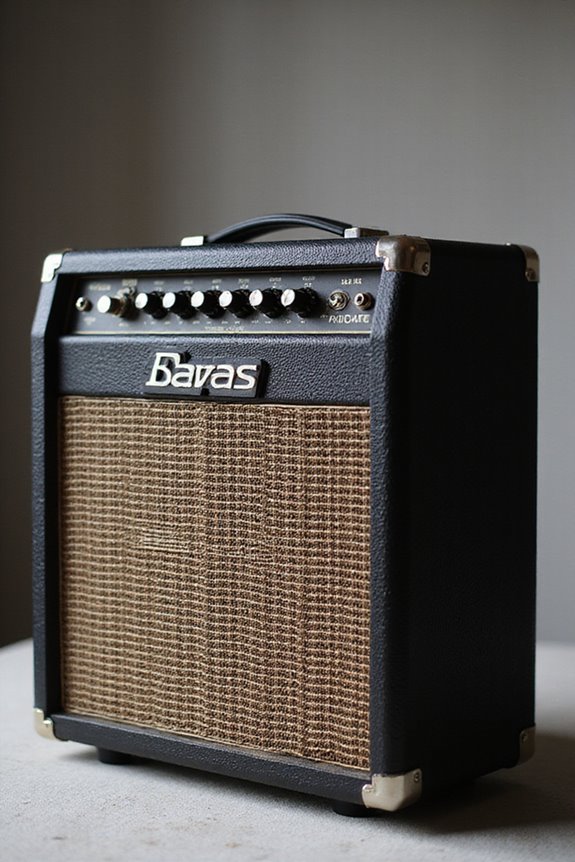
What Power Do I Need For My Guitar Amplifier?

When choosing power for your guitar amplifier, we should consider the venue size and our musical style. For home practice, 10 to 20 watts is usually sufficient. Small gigs require about 20 to 30 watts, while medium venues benefit from 50 to 90 watts for clean sound. High wattage, above 100 watts, supports larger arenas. It’s crucial to balance sound quality with wattage needs. If we explore further, we’ll uncover specific amp features that enhance our performances.
Key Takeaways
- Home practice generally requires 10 to 20 watts for distortion-free sound; small gigs need 20 to 30 watts for clarity.
- Medium-sized venues benefit from amps rated at 50 to 90 watts for sufficient clean headroom.
- Larger venues, such as arenas, typically require 100 watts or more for strong sound projection.
- Consider your musical genre; rock and metal often need 50 to 100 watts for impactful distortion while jazz prefers 50 to 90 watts.
- Always balance wattage needs with sound quality and personal preference, ensuring the amp suits your performance environment.
Understanding Wattage Requirements for Venues
You may be interested
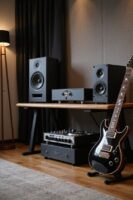


When considering wattage requirements for different venues, it’s essential to recognize that sound amplification needs vary considerably based on the setting and audience size. For home practice, we usually find that 10 to 20 watts does the job without distortion. Small gigs, such as in bars, typically require 20 to 30 watts to guarantee our sound cuts through the mix. When we step into medium-sized venues, we should aim for 50 to 90 watts, which provides the clean headroom we need for genres like jazz. On the larger side, arenas usually call for powerful amps of 100 watts or more. By following these wattage guidelines tailored to venue types, we can enhance our sound experience and connect with our audience. Additionally, understanding amp wattage requirements can help in selecting the right amplifier for your specific needs.
Recommended Products

300 Watt All tube Head

MODERN TECHNOLOGY: The Tone Master Super Reverb features the most powerful convolution-based technologies designed to recreate the famous Fender classic reverb and tremolo effects

Achieve legendary tube tones via many of the player-centric designs such as touch sensitivity dynamics, pedal friendly pre amp and various inputs that will even blend both the Normal and Bright channels.
Wattage Considerations for Different Music Styles
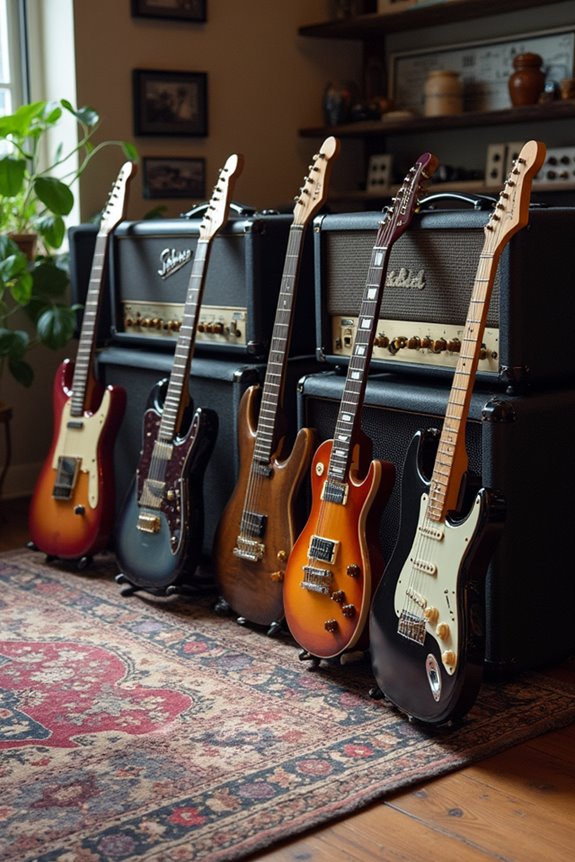
Understanding wattage needs is essential as different music styles have distinct requirements, influencing our choice of amplifiers. For jazz, funk, and ska, lower wattage preferences—around 50 to 90 watts—work best for those clean tones. You’ll find that tube amps deliver the clarity we crave without distortion. In contrast, rock and metal genres demand more heft, often benefiting from 50 to 100 watts to maintain that impactful distortion. In smaller settings, like home practices or small gigs, sticking to 10 to 30 watts allows us to control volume while retaining sound quality. Additionally, choosing amplifiers with closed-back designs can enhance bass response, making them suitable for different genres. Ultimately, aligning our wattage to genre specifications not only enhances our tone but also enriches our playing experience. Let’s find that perfect fit for our music!
Recommended Products

2 x 10" Tube Guitar Combo Amp with Harmonic Tremolo

Massive digital processing is used to faithfully Modeling the circuitry and 22-Watt power output of an original Twin reverb amplifier

Versatile power options with 50W, 2W, and Sag settings for optimal performance at any volume level
The Importance of Headroom in Amplifiers

Headroom plays an essential role in how we experience our guitar amplifiers, especially under varying playing conditions. The headroom significance cannot be overstated; it defines how clean our tone remains at higher volumes. With amps that offer high headroom, we can play dynamically without unwanted distortion, even amidst a loud band. For instance, a 50-watt amp typically provides ample headroom for clear tones when jamming with drums and bass. In contrast, low-wattage amps often distort early, limiting our tonal options. By understanding headroom, we can choose the right amp that matches our playing style, ensuring our effects and pedals shine while preserving that essential clean tone we all crave. Additionally, power output requirements, such as 5 to 10 watts for home use, can significantly affect the amount of headroom available in an amplifier.
Distortion Characteristics of Low vs. High Wattage Amps

In considering the differences in distortion characteristics between low and high wattage amps, we quickly realize that our choices greatly shape our playing experience. Low wattage amps produce harmonic distortion at lower volumes, allowing us to achieve warm, saturated tones that are perfect for classic rock or blues. We can enjoy tube distortion without overwhelming our surroundings.
On the other hand, high wattage amps offer tremendous clean headroom but require us to crank the volume for that punchy power amp saturation. While they produce complex harmonics, solid state distortion can often sound harsher than the smooth warmth of tube amps. Ultimately, our musical preference will guide us toward the amp that aligns best with our desired tonal differences. Additionally, understanding the ideal wattage for home use can help you select an amp that fits your specific performance needs.
Practical Usage Contexts for Guitar Amplifiers

When it comes to selecting a guitar amplifier for practical usage, we must consider the specific contexts in which we’ll be playing. For home practice, amps rated at 15 to 25 watts provide the perfect solution. They offer manageable volume, allowing us to explore tone without overwhelming noise. In gig settings, we recommend opting for amps in the 20 to 50 watt range, ensuring our sound cuts through any mix, especially with drums and bass. A 50-watt amp helps deliver clear headroom during small performances, creating a richer live experience. Ultimately, matching our amp’s wattage to our playing environment allows us to express ourselves fully, whether we’re jamming at home or rocking out on stage. Additionally, higher wattage delivers stronger sound effects, enhancing overall performance quality.
Recommended Products

Powerful 100-watt pedal power amplifier with authentic valve amp tones

Battery-powered stereo keyboard amplifier; highly efficient power section with 30 watts of power (15 watts x 2) Runs on eight AA batteries or included AC adapter; removable cartridge for easy battery replacement (Best with Polaroid AA Batteries)
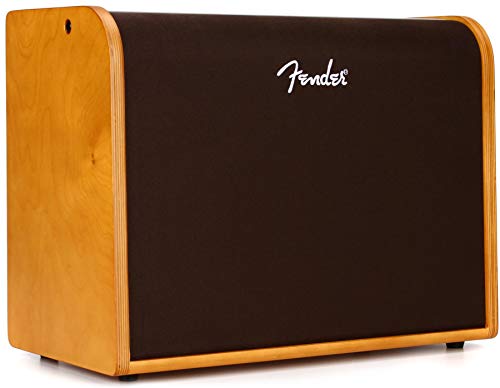
The Fender Acoustic Guitar Amplifier features 100 Watts, 14Hx18.5Wx9.25D inches
Matching Amplifier Power Ratings With Speakers
To guarantee ideal performance and protect our equipment, we should match our amplifier’s power ratings with our speakers. Ideally, an amplifier’s output should be between 75% and 150% of the speaker’s RMS rating. If we use an underpowered amp, we might face amplifier clipping, causing distortion that can lead to electrical damage. On the other hand, an overpowered amp offers better headroom and sound quality without immediate harm, improving speaker longevity. It’s vital to avoid constantly driving the amp at maximum output, as it risks damaging speakers. Remember, maintaining the right balance not only enhances our sound but also prolongs the life of our gear. Let’s keep our rig humming beautifully!
Recommended Products

Powerful, portable system with two channels designed for instrument or microphone use

I/O Designed for Contemporary Applications

Competition Grade Class D MOSFET Monoblock Power Amplifier
Power Consumption and Its Technical Aspects
Understanding how power consumption works in guitar amplifiers is just as important as matching power ratings with speakers. Power consumption, measured in watts, can vary from 1W in practice amps to over 100W in stage setups. Here, efficiency plays a vital role—solid-state amps are typically more power-efficient than their tube counterparts, often generating less heat. However, tube amps provide a warm sound that many players love. We must also consider heat dissipation; higher wattage requires better cooling mechanisms to prevent thermal damage and guarantee longevity. By grasping these aspects, we can make informed decisions about our equipment, maximizing performance while minimizing energy waste in our setups.
Why Wattage Matters in Live Performances
In live performances, wattage plays an essential role in shaping the overall sound and dynamics of a band. Higher wattage amplifiers not only provide the volume we need to compete with loud drummers and brass sections but also guarantee our sound remains clear and present during live mixing. A 50 to 90-watt amp often strikes the perfect balance, giving us the headroom to express our sound without distortion. In larger venues or festivals, using 100 watts or more allows us to cut through the mix and maintain tonal clarity, adapting easily to different sound dynamics. Plus, if we’re working with tube amps, they enhance our tonal richness as the volume increases, making live performance even more engaging.
Selecting the Right Amplifier for Your Needs
How can we guarantee we choose the right amplifier for our specific needs? First, let’s consider amp types and our playing environment. For home use, a 1 to 20-watt amp is often sufficient, providing a clear sound without too much volume. When we rehearse or gig in small spaces, 5 to 15 watts can deliver nice cleans but may struggle at high volumes. If we’re performing in small bars, we should think about tube amps between 20 and 45 watts for that rich tone we love. Our tone preferences—do we want clean sounds or some distortion?—also guide our choices. Ultimately, we need to balance our wattage needs with our musical style and performance settings for the best results.
Recommended Products

20-watt 2-channel All-tube 1x12" Guitar Combo Amplifier with Jensen C12Q Speaker

On-board studio quality reverb - Switchable FX loop

20-watt 1-channel All-tube 1x12" Guitar Combo Amplifier with 3 Switchable Voices
Frequently Asked Questions
How Does Wattage Affect Tonal Quality in My Amplifier?
When considering how wattage impacts tonal dynamics, we find that higher wattage often provides more headroom, allowing cleaner tones. Yet, lower wattage amps deliver rich, warm sounds, making our tonal choices deeply personal and shared.
Can a Low Wattage Amp Sound Loud Enough for Gigs?
Did you know that 1-20 watt amps are often perfect for small gigs? We’ve found low wattage amps offer impressive gig suitability, especially with a PA system, providing great tone without the bulk of higher wattage gear.
What Is the Relationship Between Wattage and Amp Size?
When we explore the relationship between wattage and amp classification, we find wattage impacts sound quality, headroom, and volume. Understanding these elements helps us in selecting the right amp for our musical journey.
Do All Tube Amps Provide the Same Wattage Output?
Did you know that a 15-watt tube amp can often sound as loud as a 90-watt solid-state amp? We should be mindful of tube amp variations and common wattage misconceptions, as they impact our choices considerably.
How Can I Determine the Right Speaker Pairing for My Amp?
When figuring out the right speaker pairing for our amp, we should focus on impedance matching and speaker sensitivity. This guarantees we’ll achieve the best sound quality while avoiding damage to our equipment.